Virtual environment: Difference between revisions
Jump to navigation
Jump to search
| Line 71: | Line 71: | ||
!Mem | !Mem | ||
!HDD | !HDD | ||
! | !........................ | ||
!10.102.0.1 | !10.102.0.1 | ||
!routertestar | !routertestar | ||
Revision as of 22:10, 23 November 2019
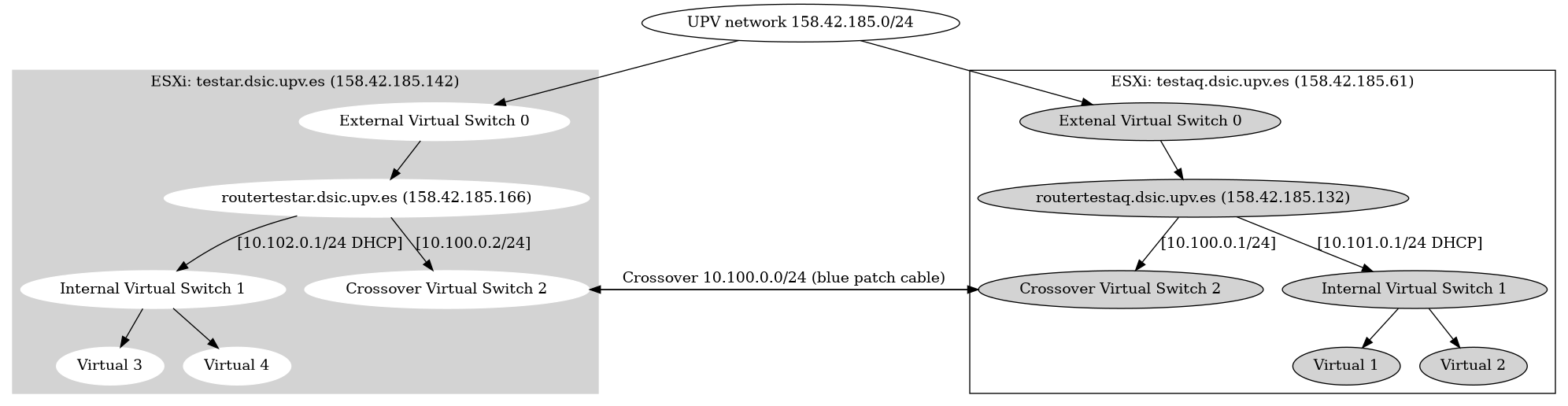
Virtual Environment @ UPV
OpenVPN Client configuration
On the routertestar.dsic.upv.es and routertestaq.dsic.upv.es an OpenVPN server is installed. Users can connect to one of the routers via OpenVPN. A user certificate needs to be created and added to an OpenVPN client configuration. To create a OpenVPN client configuration please follow the following steps:
- Log into
routertestar.dsic.upv.es - Become
rootuser - Read the OpenVPN CA password in
/root/testar-ca-key-password.txt - Run the following command:
openvpn-users.sh - Follow the instructions of the script and give the CA password when asked. 2 OpenVPN configuration files will be created and the certificates will be distibuted to the 2 testar routers
- Copy the generated OpenVPN configurations files from the /root/ directory to your own computer with scp/winscp
- Distribute the OpenVPN configuration files to the end user, so they can import this in their OpenVPN client.
Virtual machines
| 10.101.0.1 | routertestaq | CPU | Mem | HDD | ........................ | 10.102.0.1 | routertestar | CPU | Mem | HDD |
|---|---|---|---|---|---|---|---|---|---|---|
| 10.101.0.2 | Windows10 Guy 01 | 2 | 8GB | 128GB | 10.102.0.2 | Windows 10 Ad Mulders 01 | 2 | 8GB | 128GB | |
| 10.101.0.3 | 10.102.0.3 | Windows 10 Ad Mulders 02 | 2 | 8GB | 128GB | |||||
| 10.101.0.4 | 10.102.0.4 | |||||||||
| .. | .. | |||||||||
| 10.101.0.99 | 10.102.0.99 |